Layered Mirrors Gave Our Small Bedroom the Light It Had Been Missing
For years, our bedroom had been a comfortable, welcoming, and personal space, but never particularly bright. It is not a large room to begin with, and even though the Florida sun pours into most parts of our home, the bedroom always stayed a little dimmer than I wished. Some afternoons the light would drift in…
For years, our bedroom had been a comfortable, welcoming, and personal space, but never particularly bright. It is not a large room to begin with, and even though the Florida sun pours into most parts of our home, the bedroom always stayed a little dimmer than I wished.
Some afternoons the light would drift in softly through the curtains, but by evening the room felt heavier, as if the walls were inching closer.
I used to think there was nothing I could do about it without knocking down walls or rearranging furniture in ways that didn’t make sense for our lifestyle.
But one night, while folding laundry, I stumbled on a home makeover segment on a TV channel – a show I don’t usually watch, but the host was talking about simple tricks to expand small rooms without renovating, and her enthusiasm made me pause.
She explained that one of the most underestimated tools in decorating small spaces is the mirror – not just one, but mirrors layered and arranged intentionally so that light has multiple surfaces to travel across.
Where the Idea of Layering Mirrors Came From
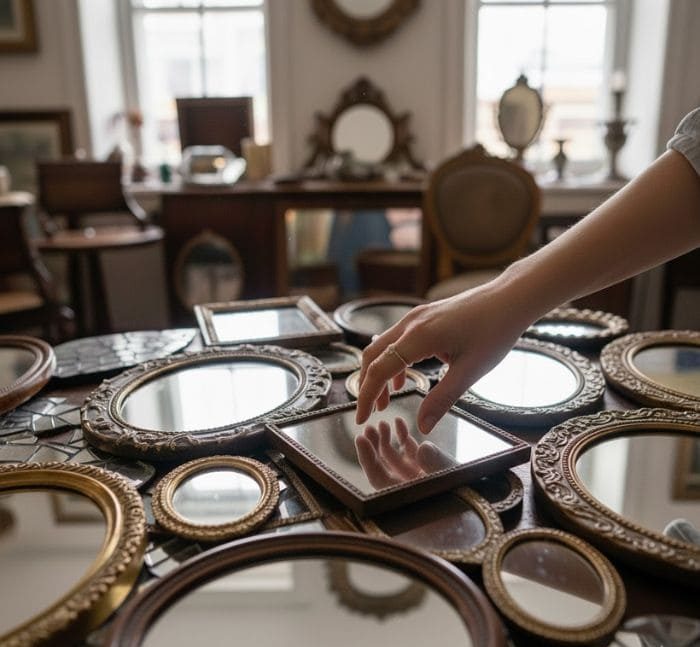
I had always believed mirrors were functional objects, something you check your hair in or lean against a dresser. The idea that they could shape the atmosphere of a room felt surprisingly creative to me.
The TV host described mirrors as quiet amplifiers, pieces that don’t demand attention yet completely transform the way a space feels.
That night, after the girls went to sleep, I walked into our bedroom with a fresh pair of eyes. I stood near the foot of the bed and looked at the blank wall across from the window. It was a wall I never paid much attention to, but it suddenly felt like the perfect place to invite more light in.
Choosing the Suitable Mirrors
I didn’t want to rush the process or buy a full set from one store. Layered mirrors work best when each piece has its own personality with different sizes, shapes, and frames that blend together the way books blend on a shelf.
Over two weeks, I collected mirrors from:
- a small antique shop in town where I found a rounded gold-framed mirror with tiny faded detailing
- a thrift store where a rectangular mirror with a whitewashed frame caught my eye
- our own hallway closet, where an old oval mirror from our North Carolina home had been wrapped in paper since the day we moved
- Each mirror felt like a piece of something bigger, even before I knew exactly how I would arrange them.
I stayed away from heavy frames because the room already felt small, and I wanted the mirrors to feel airy, lightweight, and reflective.
Arranging the Layered Look on the Wall
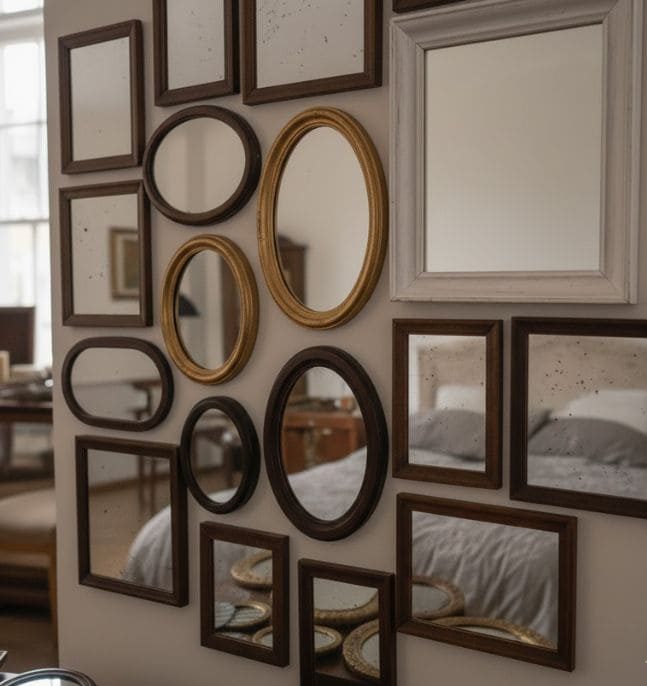
Layering mirrors is more delicate than it sounds. It isn’t about stacking them on top of each other but allowing their edges to overlap visually, creating movement and depth without clutter.
I started with the largest mirror, the soft gold rounded one, and positioned it slightly off-center on the wall across from the window. I wanted it to catch the natural light first.
Then, a few inches to the right and slightly higher, I placed the whitewashed rectangular mirror. Its shape added structure, almost like a calming boundary.
The oval mirror came last, placed lower and overlapping the visual space between the other two. Together, they resembled a gentle cluster.
Daniel helped me measure everything, of course. He always teases me that I decorate with my heart first and a measuring tape second, and he’s right. But in this case, our teamwork paid off.
How the Layered Mirrors Changed the Room Instantly
The next morning, when I walked into the bedroom with my coffee, I paused in the doorway.
The light bouncing around the room felt gentle but present, and the mirrors made it look as though the room had gained an invisible window. Even Milo wandered in and tilted his head, seeing reflections he didn’t recognize.
At night, when the lamps were on, the mirrors made the glow feel warmer. Instead of the light fading into the corners, it danced softly across the room, making everything feel calm and settled.
The biggest surprise was how the mirrors softened the room’s edges. The walls no longer felt like they were closing in; they felt fluid, subtly expanding through reflection.
Here’re Necessary Things to Remember
Adding layered mirrors to a small bedroom is one of the simplest decorating choices I’ve ever made, yet the effect feels truly transformative.
If I have to give advice, I’ll say mixing shapes creates warmth and uses frames that match your home’s tone. Soft golds, creams, and light woods blend beautifully in a white-cream home.
In addition, don’t overthink symmetry. Asymmetry gives personality to small rooms. And layering invites movement. When mirrors overlap visually, the room gains depth without needing more space.
Most of all, I learned that small bedrooms don’t need more furniture to feel bigger. They need intention as thoughtful choices that invite more light, more softness, and more ease into the space.